How much does it cost to pour concrete in 2025? Whilst it would be easy to give a simple “per metre” price, it would be misleading and potentially costly for your project planning. The final cost represents a combination of three key factors: the concrete itself, the volume you need, and the delivery method required. Understanding these components ensures accurate budgeting and prevents unpleasant surprises when quotes arrive.
As a senior estimator who calculates concrete costs daily, I’ll give you the inside perspective on what really determines your final price—and why a custom quote is the only way to get a reliable figure for your specific project.
Cost Factor #1: The Concrete Itself (The Material)
The base material cost per cubic metre (m³) forms the foundation of any concrete quote, but this isn’t a fixed number. Several variables significantly impact the final price per metre.
Strength Grade Requirements Your project’s structural demands directly affect material costs. A standard C25 mix suitable for domestic patio bases costs considerably less per metre than high-strength C40 concrete required for commercial foundations or structural beams. When exploring different types of concrete strengths, the price differential between grades can represent 15-25% of total material costs.
Specialist Admixtures Modern concrete often requires performance-enhancing chemicals that adjust the base price significantly. Need concrete that sets faster for winter projects? Require waterproofing admixtures for basement applications? Each specialised additive increases the material cost. Understanding what are concrete admixtures helps explain why two seemingly identical concrete orders can have substantially different prices.
Mix Design Complexity Standard mixes cost less than bespoke formulations. Specify unusual aggregate types, multiple admixtures, or non-standard proportions, and material costs increase accordingly. Ready mix concrete prices reflect the complexity of meeting specific performance requirements rather than simply providing basic concrete.
Cost Factor #2: The Delivery (Getting It to Your Site)
Material costs represent only part of your total investment. Getting concrete from the batching plant to your formwork involves logistics costs that vary dramatically based on site conditions and placement requirements.
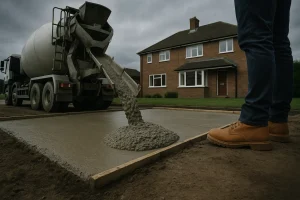
Direct Pour Applications The most economical delivery method occurs when trucks can park directly adjacent to pour areas, allowing concrete to flow via chutes into position. This scenario minimises additional equipment costs but requires excellent site access and nearby formwork positioning.
Concrete Pumping Requirements Any situation preventing direct truck access requires concrete pumping services—a separate hire cost that often proves the most cost-effective solution despite the additional expense. Concrete pumping eliminates massive labour costs whilst enabling placement in locations impossible through direct pouring.
Concrete pump hire cost varies by pump type and duration:
- Line pumps for restricted access: £300-500 per day
- Boom pumps for height/reach: £500-800 per day
Whilst pumping adds immediate costs, it frequently reduces total project expenses through eliminated labour and faster completion times.
Distance and Accessibility Delivery charges reflect distance from batching plants and site accessibility challenges. Remote locations, narrow access routes, or challenging ground conditions all impact the final delivery cost included in your quote.
Cost Factor #3: The Volume (Economy of Scale)
Total project volume significantly influences per-metre costs through economies of scale and minimum order considerations.
Volume Efficiency Larger orders (8m³+) typically achieve better per-metre pricing than small quantities due to delivery efficiency. However, concrete suppliers often accommodate smaller volumes through volumetric mixing that eliminates minimum order restrictions whilst maintaining competitive pricing.
Order Optimisation Using a concrete calculator before requesting quotes ensures accurate volume calculations that prevent over-ordering waste or under-ordering delays. Precise calculations enable suppliers to provide accurate quotes whilst avoiding the cost implications of quantity errors.
Waste Considerations Allow 5-10% extra volume for waste, spillage, and minor calculation errors. Professional estimators factor this contingency into cost calculations, but DIY planners often overlook this essential buffer.
So, What’s the Ballpark Figure?
For standard-grade concrete mix in 2025, you might see material prices in the region of £120-£150 per cubic metre. However, this figure emphatically does not include:
- Specialist admixtures or high-strength grades
- Delivery charges
- Separate concrete pump hire costs
- VAT at 20%
This wide range explains why generic pricing proves unhelpful for accurate project budgeting. Real costs depend entirely on your specific requirements, location, and site conditions.
The Smartest First Step You Can Take
Before requesting quotes, use an online concrete calculator to determine your precise volume requirements. This essential first step enables accurate discussions with suppliers whilst demonstrating project preparation that often results in more competitive pricing.
Accurate volume calculations also help you understand whether DIY alternatives like bagged concrete might suit smaller projects, though cost to lay concrete professionally often proves more economical than anticipated once all factors are considered.
Getting Your Real Number
These cost factors demonstrate why accurate pricing requires detailed project assessment rather than generic per-metre figures. Professional suppliers need to understand your strength requirements, site accessibility, volume needs, and timing constraints before providing reliable quotes.
The most accurate approach involves discussing your specific project with experienced suppliers who can recommend optimal concrete grades, assess delivery requirements, and provide transparent pricing that reflects your actual needs rather than industry averages.
Ready to move from estimates to accurate pricing? Contact us for a detailed, no-obligation quote that addresses your specific project requirements and provides the reliable figures essential for confident project planning.
Frequently Asked Questions
Is it cheaper to mix concrete myself? Not for any significant volume when you factor in time, quality consistency, and total material costs. Hand-mixing becomes expensive and exhausting beyond 5-10 bags, whilst professional delivery often costs less than DIY materials plus tool hire for larger projects.
Is pump hire included in the price per cubic metre? No, pumping represents a separate service with distinct costs. However, pumping often reduces total project costs through eliminated labour and faster completion, making it economically advantageous despite the additional hire charge.
How much extra should I budget for unexpected costs? Allow 10-15% contingency for volume variations, site complications, or specification changes. Professional quotes typically include minor contingencies, but significant scope changes require pricing adjustments regardless of initial estimates.
Do prices vary significantly between suppliers? Material costs remain relatively consistent between quality suppliers, but service levels, delivery capabilities, and technical support vary considerably. Choose suppliers based on total value rather than purely price-based decisions that may compromise project outcomes.