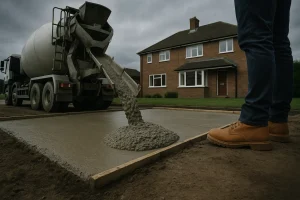
Concrete isn’t a single, uniform product. This versatile building material comes in numerous formulations, each precisely engineered for specific construction demands. The most crucial property that distinguishes one concrete mix from another is its strength—specifically, its ability to resist compression. Understanding compressive strength and how it relates to real-world applications is essential for anyone involved in construction projects, from domestic extensions to major infrastructure developments.
How We Measure Concrete Strength: MPa and ‘C’ Grades Explained
Compressive strength measures how much force concrete can withstand before it fails under compression. In the UK and Europe, we measure this property in Megapascals (MPa)—a unit that quantifies the pressure applied per square millimetre of concrete surface.
The construction industry uses a standardised ‘C’ grading system to classify concrete strength grades UK-wide. Each grade features a number that directly corresponds to the minimum compressive strength measured after 28 days of curing. For example, C25 concrete delivers a minimum compressive strength of 25 MPa, whilst C30 concrete provides 30 MPa. This concrete MPa explained system ensures consistency across projects and suppliers, allowing engineers and contractors to specify exactly the performance characteristics they require.
The 28-day measurement period is crucial because concrete continues gaining strength long after initial setting. This standardised timeframe provides a reliable benchmark for comparing different mixes and ensuring structural integrity.
A Guide to Concrete Grades and Their Common Applications
Low-Strength Concrete (C10 – C15)
These grades serve non-structural applications where high strength isn’t required but concrete’s other properties—durability, workability, and cost-effectiveness—provide value. C10 and C15 concrete commonly appear in blinding applications, creating a level, clean surface beneath foundation footings. You’ll also find these grades used for kerb bedding, agricultural shed flooring, and basic hardstanding areas where vehicle loads remain light.
The lower strength doesn’t indicate poor quality; rather, these mixes are optimised for applications where structural demands are minimal, making them cost-effective choices for appropriate uses.
General & Domestic Concrete (C20 – C25)
This category represents the workhorse of residential and light commercial construction. C20 and C25 grades strike an ideal balance between performance, workability, and cost for most domestic applications.
C25 concrete particularly excels in domestic foundation work, providing adequate concrete strength for foundations supporting typical residential structures. Garden patios, garage floors, and domestic driveways benefit from C25’s durability and weather resistance. The grade handles normal foot traffic, occasional vehicle loads, and seasonal temperature variations without compromising structural integrity.
Understanding what is C25 concrete used for helps homeowners and contractors make informed decisions for residential projects. Its versatility makes it suitable for most non-commercial applications whilst remaining economically sensible for domestic budgets.
Commercial & High-Traffic Concrete (C30 – C40)
As structural demands increase, these higher grades become essential. C30 and C35 concrete handle the increased loads and stresses found in commercial environments, busy pavements, and reinforced concrete structures.
Commercial building foundations often specify these grades, particularly where heavy machinery, substantial foot traffic, or multi-storey loads require enhanced performance. Car parks, industrial floors, and heavily trafficked public pavements rely on C30-C40 concrete for long-term durability under demanding conditions.
These grades also feature prominently in reinforced concrete applications, where steel reinforcement bars work in combination with the concrete matrix to create structural elements capable of handling both compression and tension forces.
High-Strength & Specialist Concrete (C45 and Above)
High strength concrete grades serve the most demanding structural applications. C45, C50, and higher grades appear in major civil engineering projects where exceptional performance is non-negotiable.
Bridge construction, multi-storey car parks, and pre-stressed concrete beams require these advanced formulations. The enhanced strength allows for more slender structural elements, reducing material usage whilst maintaining safety margins. High-rise buildings often specify these grades for critical load-bearing elements where space constraints demand maximum strength-to-size ratios.
These specialist mixes require careful handling and often incorporate advanced admixtures to achieve their superior performance characteristics.
What Determines a Concrete’s Strength?
Several factors influence the final strength of concrete, with the water-to-cement ratio being the most critical. Lower water content generally produces higher strength, as excess water creates voids within the cured concrete matrix. However, understanding the core composition of concrete reveals that achieving optimal strength requires balancing workability with performance.
The quality of the aggregates significantly impacts final strength. Clean, well-graded aggregates with appropriate hardness contribute to stronger concrete matrices. Poor-quality aggregates with excessive dust, organic contamination, or weakness can compromise even well-designed mixes.
The curing process also plays a vital role. Proper moisture and temperature control during the initial weeks allow the cement hydration process to proceed optimally, achieving the designed strength characteristics.
Conclusion
Choosing the right concrete strength isn’t merely about meeting minimum requirements—it’s about optimising performance, durability, and cost-effectiveness for each specific application. Over-specifying wastes money and resources, whilst under-specifying compromises safety and longevity.
Whether you’re planning a domestic driveway or a commercial development, selecting appropriate concrete strength grades ensures your project meets both current needs and future demands. Whether you choose volumetric or ready-mix concrete, understanding these strength classifications helps you communicate effectively with suppliers and contractors.
For accurate project planning, ensure you order the right amount with a concrete calculator matched to your specific strength requirements.
Frequently Asked Questions
What’s the difference between C25 and C30 concrete for foundations? C30 provides 20% higher compressive strength than C25, making it suitable for heavier structures or challenging ground conditions. For standard domestic foundations, C25 typically suffices, whilst C30 offers additional security for larger buildings or areas with high groundwater.
Can I use C20 concrete for a driveway? C20 concrete works adequately for domestic driveways with light vehicle traffic. However, C25 provides better long-term durability and resistance to cracking, making it the preferred choice for most residential driveways.
How long does concrete take to reach its full strength? Concrete achieves approximately 70% of its design strength within 7 days and reaches full strength after 28 days under normal curing conditions. Some strength gain continues beyond 28 days, particularly in dense, high-quality mixes.
Is higher strength concrete always better? Not necessarily. Higher strength concrete costs more and can be less workable. Choose the strength that matches your application’s requirements—using C40 for a garden path wastes money, whilst using C20 for a commercial foundation compromises safety.