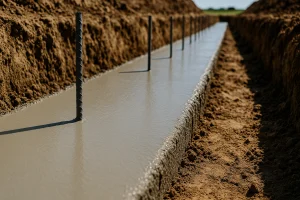
Understanding concrete setting times is crucial for any construction project in the UK. Whether you’re a contractor laying a foundation in Leeds or a homeowner starting a DIY patio in Manchester, knowing when your concrete will be ready saves you time, money, and prevents costly mistakes.
Quick Answer: Concrete Setting Times at a Glance
- Initial Set: 30 minutes to 2 hours
- Final Set: 24-48 hours
- Full Strength: 28 days
However, these times can vary significantly based on several factors we’ll explore in detail below.
Understanding Concrete Setting vs Curing
Before diving into specific timeframes, it’s important to understand the difference between setting and curing:
- Setting refers to the initial stiffening of the concrete mix, making it hard enough to support light foot traffic.
- Curing is the complete chemical process of hydration that gives concrete its full, long-term strength.
The Science Behind Concrete Setting
When cement mixes with water, a chemical reaction called hydration begins. This process generates heat and gradually transforms the liquid mixture into solid concrete. The setting process happens in two distinct phases:
Initial Set (Plastic State):
- Concrete begins to stiffen but remains workable.
- Typically occurs 30 minutes to 2 hours after mixing.
- You can still make minor adjustments during this phase.
Final Set (Hardened State):
- Concrete becomes firm and can support light loads.
- Usually happens within 24-48 hours.
- Walking on the surface becomes safe.
Typical Concrete Setting Timeframes
Standard Ready-Mix Concrete
For typical BSI-certified ready-mix concrete used in UK construction projects:
- 2-6 Hours: Surface becomes firm to the touch.
- 24 Hours: Safe for light foot traffic.
- 48 Hours: Can support heavier loads and formwork can often be removed.
- 7 Days: Reaches approximately 70% of its full strength.
- 28 Days: Achieves its full design strength.
Fast-Setting Concrete
Fast-setting concrete mixes are available for urgent projects:
- 15-30 Minutes: Initial set.
- 1-2 Hours: Final set.
- 24 Hours: Ready for full use.
Note: Fast-setting concrete typically costs more than standard mixes. Contact our team for a precise quote.
Different Project Types and Setting Times
Footings and Foundations:
- Wait 48-72 hours before removing formwork.
- Allow 7 days before applying full structural loads.
Driveways and Pathways:
- Light foot traffic: 24 hours.
- Vehicle traffic: A minimum of 7 days is essential.
Patios and Slabs:
- Light use: 24-48 hours.
- Placement of heavy furniture: 7 days.
Fence Posts:
- Initial stability: 4-6 hours.
- Full load-bearing: 24-48 hours.
8 Key Factors That Affect Concrete Setting Time
1. Temperature
Temperature has the most significant impact on setting times:
- Cold Weather (Below 5°C): Setting time increases dramatically. Procon 24/7 can advise on heated enclosures or specialized additives.
- Hot Weather (Above 25°C): Accelerates setting time, requiring careful timing and potentially retarding additives.
- Optimal Temperature (15-20°C): Ideal conditions for consistent and predictable results.
2. Humidity and Moisture
- High Humidity: Slows evaporation, extends workable time, and aids long-term strength.
- Low Humidity: Accelerates surface drying, reduces working time, and may require additional curing measures.
3. Concrete Mix Design
- Cement Content: Higher cement content generally means faster setting.
- Water-to-Cement Ratio: A lower ratio results in stronger concrete but can set faster. Our volumetric mixers ensure the perfect ratio on-site.
- Aggregates: The type and size of aggregates can influence setting times.
4. Additives and Admixtures
- Accelerators: Can reduce setting time by 30-50%, ideal for cold weather.
- Retarders: Slow the setting process, which is useful for complex pours or in hot weather.
5. Wind Conditions
Strong winds increase the evaporation rate from the surface, which can cause cracking and require wind barriers.
6. Concrete Thickness
- Thin Sections (Under 100mm): Set faster due to a larger surface area relative to their volume.
- Thick Sections (Over 300mm): Retain heat longer, which can slow the overall setting time.
7. Subgrade Conditions
- Absorbent Subgrade (e.g., dry soil): Can draw moisture from the concrete, accelerating the set.
- Non-absorbent Subgrade (e.g., plastic sheeting): Retains moisture, allowing for a more standard setting time.
8. Concrete Type and Grade
- Standard Concrete (C20/25): Used for most domestic applications and follows standard setting times.
- High-Performance Concrete (C40/50+): Often sets faster due to higher cement content.
Concrete Setting Times by UK Region
As a supplier across the North West and Yorkshire, we see firsthand how regional weather affects projects.
Spring (March-May)
- Expected Setting: Standard to slightly delayed due to variable temperatures.
Summer (June-August)
- Expected Setting: Perfect conditions, but can be accelerated on very hot days.
Autumn (September-November)
- Expected Setting: Standard, but increasing rain may extend times.
Winter (December-February)
- Expected Setting: Significantly delayed; frost protection measures are often necessary.
How to Test if Concrete Has Set
- Visual Inspection: The surface should have a uniform grey colour with no visible water.
- Thumb Test: If you press your thumb firmly on the surface and it leaves no impression, it has reached its initial set.
- Professional Methods: For critical applications, penetration resistance testing or core sampling is used.
What Happens if You Don’t Wait Long Enough?
- Surface Damage: Footprints, impressions, and a weak, powdery surface.
- Structural Issues: Reduced strength and cracking from premature loading.
- Cost Implications: Potential for costly repairs or complete reconstruction.
Tips for Managing Concrete Setting Times
1. Use the Right Additives
Procon 24/7 can supply concrete with accelerators or retarders to suit your project’s schedule and weather conditions.
2. Optimize Mix Design
Our team can help you select the right concrete grade and mix for your specific needs. Using our volumetric mixers means you get the freshest possible concrete, mixed on-site to your exact requirements.
3. Control Environmental Conditions
Use heated enclosures in cold weather and provide wind protection on gusty days.
4. Plan Your Pour
Schedule your concrete delivery for a day with optimal weather conditions. We offer flexible delivery, including same-day and next-day service.
Common Concrete Setting Problems and Solutions
Problem: Concrete Sets Too Quickly
- Solutions: Use retarding admixtures, work during cooler parts of the day, and cover with a curing compound.
Problem: Concrete Won’t Set Properly
- Causes: Too much water in the mix, contaminated aggregates, or extreme cold.
- Solutions: Rely on our BSI-certified mixes to ensure quality and provide frost protection when needed.
Problem: Surface Cracking
- Solutions: Apply a curing membrane immediately after finishing and cover with plastic sheeting to retain moisture.
When to Call the Professionals at Procon 24/7
Consider our professional concrete services when you need:
- Guaranteed Quality: Our concrete is BSI-certified, ensuring consistent performance.
- No Waste: With our volumetric mixers, you pay only for what you use.
- Access to Any Area: Our concrete pumping services can deliver concrete precisely where you need it.[1]
- Expert Advice: Our team can help you choose the right mix for your project.
At Procon 24/7, we have years of experience delivering ready-mix and volumetric concrete across Yorkshire and the North West. Our expert team understands exactly how local weather conditions affect concrete setting times and can provide guidance tailored to your specific project.
Regional Considerations for UK Projects
Northern England (Our Specialty)
Yorkshire & North West: Cooler average temperatures can extend setting times, while higher rainfall requires careful planning. Our local depots in Leeds, Warrington, and Wakefield are perfectly positioned to provide timely service.
Frequently Asked Questions
Can I speed up concrete setting time?
Yes, using concrete accelerators or a higher cement content can speed up the process. Our team can advise on the best approach.
What happens if it rains on fresh concrete?
Light rain after the initial set can aid curing. Heavy rain on fresh concrete can damage the surface; we recommend covering it if rain is forecast.
How long should I wait before removing formwork?
For most applications, wait at least 48 hours. For structural elements, 7 days is a safer benchmark.
Can I walk on concrete after 24 hours?
Yes, for most residential applications like patios and paths, concrete can support foot traffic after 24 hours.
Does concrete continue to get stronger after 28 days?
Yes, concrete continues to gain strength for years, but 28 days is the industry standard for measuring its design strength.
What’s the difference between setting and curing?
Setting is the initial hardening (24-48 hours), while curing is the full strengthening process (28 days).
Conclusion: Getting Your Timing Right
Understanding concrete setting times is essential for a successful project. While standard ready-mix concrete typically sets in 24-48 hours, factors like temperature, humidity, and mix design play crucial roles.
Key Takeaways:
- Plan concrete pours around favourable weather conditions.
- Allow adequate time for setting before applying loads.
- Use a professional service like Procon 24/7 for expert advice and reliable delivery.
Ready for your next concrete project in Yorkshire or the North West? Contact Procon 24/7 for expert ready-mix and volumetric concrete delivery. Our experienced team provides guidance on optimal timing and conditions for your specific project requirements.