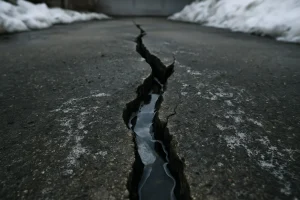
Seeing a network of new cracks appear across your driveway after a long, cold winter can be deeply alarming. You’re staring at what was once a smooth, solid surface, now marked with lines that seem to have appeared overnight. The good news is that the cause is almost always the same, it’s an extremely common issue across the UK, and most importantly, it’s completely understandable once you know what’s happening beneath the surface.
As a materials engineer who has spent decades studying concrete durability, I can reassure you that your driveway’s winter damage follows a predictable pattern that affects thousands of properties every year. Understanding this process empowers you to make informed decisions about repair, prevention, and future concrete projects.
The #1 Culprit: The Freeze-Thaw Cycle
The primary villain behind your winter concrete damage is a relentless natural process called the freeze-thaw cycle. This powerful force operates like a slow-motion hydraulic jack, gradually weakening concrete through repeated seasonal attacks. Here’s exactly how this destructive process works:
Step 1: Water Gets In Concrete appears solid to the naked eye, but it’s actually slightly porous—riddled with microscopic pores and hairline cracks invisible without magnification. During autumn rain and winter snow melt, water gradually seeps into these tiny spaces, penetrating deeper into the concrete matrix than most people realise.
Step 2: The Water Freezes & Expands When temperatures drop below zero, this trapped water transforms into ice. This change represents more than a simple phase transition—ice occupies approximately 9% more volume than liquid water. Inside confined concrete pores, this expansion creates enormous internal pressure, acting like countless tiny wedges driven simultaneously throughout the material.
Step 3: The Ice Thaws, Leaving Bigger Cracks When spring arrives and ice melts, it leaves behind enlarged cracks and expanded pores. The concrete doesn’t magically return to its original condition—the damage from expansion remains permanently, creating larger pathways for future water infiltration.
Step 4: The Cycle Repeats and Intensifies Each subsequent freeze-thaw cycle attacks these newly enlarged vulnerabilities. More water penetrates deeper, creates greater expansion forces, and causes progressively more damage. After an entire winter of repeated cycles, microscopic imperfections become visible cracks that continue growing with each seasonal attack.
This frost weathering process explains why concrete driveway cracking after winter follows such predictable patterns across the UK’s climate.
What Makes a Driveway Vulnerable? The Underlying Conditions
Whilst freeze-thaw cycles affect all concrete, certain conditions make driveways particularly susceptible to winter damage. Understanding these vulnerability factors helps explain why some driveways suffer extensive cracking whilst others remain relatively unscathed.
Poor Sub-Base Foundation A driveway’s foundation layer determines long-term stability. When the sub-base wasn’t properly compacted during installation, it shifts and settles over time, creating stress concentrations that initiate cracks. These cracks provide perfect entry points for water infiltration that fuels freeze-thaw damage.
Inadequate Concrete Quality The concrete mix itself significantly influences freeze-thaw resistance. Different types of concrete strengths perform differently under winter conditions. Concrete with excessive water content during mixing creates a more porous, weaker matrix that acts like a sponge for moisture infiltration.
Professional concrete suppliers understand that winter durability requires specific mix designs with appropriate air-entraining admixtures—microscopic air bubbles that provide relief spaces for expanding ice. DIY mixes or budget suppliers often omit these critical durability features.
Missing Control Joints Those deliberate lines cut into larger driveways aren’t decorative—they’re engineered weak points that control where inevitable cracking occurs. Without proper control joints, concrete cracks randomly, creating irregular patterns that are both unsightly and difficult to repair effectively.
Inadequate Winter Preparation Many homeowners unknowingly accelerate freeze-thaw damage through improper winter care. Pouring concrete in cold weather without proper protection often creates inherently vulnerable surfaces, whilst inadequate surface sealing allows excessive water penetration throughout winter months.
The Solutions: From Quick Fixes to Permanent Repairs
Addressing winter concrete damage requires matching solutions to the severity and extent of the problem. Options range from temporary DIY measures to comprehensive professional reconstruction.
For Minor, Hairline Cracks Small, surface-level cracks can be addressed using flexible crack fillers available from DIY stores. These polymer-based sealants provide a temporary barrier that reduces water infiltration, functioning essentially as an elastoplaster that accommodates minor concrete movement.
However, understand that crack filling represents damage control rather than permanent repair. The underlying concrete remains vulnerable to future freeze-thaw cycles, and sealed cracks often reopen as damage progresses.
For Sunken or Heavily Cracked Areas When sections of your driveway have settled or developed extensive crack networks, professional intervention becomes necessary. Modern reliable concrete repair services offer innovative solutions like concrete lifting that can sometimes restore level surfaces without complete replacement.
Concrete lifting uses high-density foam injection to raise settled sections whilst filling voids that contribute to ongoing damage. This approach proves cost-effective when concrete remains structurally sound despite surface cracking.
For Widespread, Deep Cracking Extensively damaged driveways often require complete replacement with properly engineered concrete designed for UK winter conditions. Professional reconstruction addresses underlying issues—improved sub-base preparation, appropriate concrete specifications, proper control joint placement, and protective surface treatments that prevent future freeze-thaw damage.
Prevention: Protecting Your Investment
Understanding freeze thaw damage concrete helps prevent future problems through proactive maintenance and proper specifications for new construction. Quality concrete sealers applied every 2-3 years significantly reduce water infiltration, whilst proper drainage prevents water accumulation that fuels freeze-thaw cycles.
For new driveways, specifying air-entrained concrete with appropriate strength characteristics provides built-in freeze-thaw resistance that protects your investment through decades of UK winters.
Conclusion
Winter concrete cracking follows predictable patterns driven by the relentless freeze-thaw cycle that affects all exposed concrete. Whilst concerning to discover, this damage represents a well-understood phenomenon with proven solutions ranging from temporary crack sealing to comprehensive professional reconstruction.
The key lies in accurate assessment of damage extent and appropriate solution selection. Professional evaluation helps determine whether your driveway needs simple maintenance, targeted repairs, or complete replacement designed to withstand future winter challenges.
Ready to address your concrete concerns professionally? Contact us for a detailed assessment that identifies the most appropriate solution for your specific situation and budget.
Frequently Asked Questions
Can I prevent this from happening again? Yes, through regular maintenance and proper protection. Apply quality concrete sealer every 2-3 years to reduce water infiltration, ensure proper drainage around the driveway, and address small cracks promptly before they expand during freeze-thaw cycles.
Will small cracks get bigger over time? Almost certainly, yes. The freeze-thaw cycle ensures that existing cracks collect more water each winter, creating greater expansion forces that progressively enlarge the damage. Early intervention prevents small problems from becoming expensive replacements.
How can I tell if my driveway needs professional repair? Consider professional assessment when cracks exceed 3mm width, when sections have settled noticeably, or when crack networks cover more than 25% of the surface area. These conditions indicate structural issues beyond simple surface sealing.